
.png)
The Win Rate Lie: Why Most B2B Go-to-Market Systems Enter Too Late to Win
- Brian Shea
- May 20
- 5 min read


Most executive teams believe they have a sales execution problem.
They don’t.
They have a timing problem disguised as a sales problem.
For the last decade, B2B organizations have attempted to improve revenue performance through:
More sales training
More enablement
More RevOps dashboards
More lead scoring
More pipeline reviews
More AI layered onto existing workflows
Yet win rates continue to decline.
Why?
Because most go-to-market systems are still architected around a buying motion that no longer exists.
The modern B2B buyer does not wait for sellers to educate them.
They research independently. They form buying groups early. They define requirements before engagement. And increasingly, they shortlist vendors before sellers even know an opportunity exists.
The result?
Most commercial teams are entering opportunities after the problem has already been shaped.
And no amount of pipeline inspection can fix a system designed to arrive late.
The Win Rate Data Should Terrify Revenue Leaders
The decline in B2B win rates is no longer anecdotal.
It is systemic.
Research cited across the industry shows B2B sellers are increasingly competing inside compressed buying windows where influence has already shifted upstream.
According to Gartner research, buyers spend only 17% of the total buying journey meeting with suppliers. When comparing multiple vendors, that often means a seller receives only 5–6% of the buyer’s total available time.
Gartner also reports that 67% of B2B buyers prefer a rep-free experience.
Meanwhile, modern buying behavior research shows:
Buyers increasingly self-direct research
Requirements are often established before sales engagement
Preferred vendors frequently emerge before formal evaluations begin
Corporate Visions summarized the shift clearly:
“92% of B2B buyers start their journey with at least one vendor already in mind.”
This is not simply a sales productivity issue.
It is evidence that the traditional MQL-based GTM model is structurally late.
Most Firms Don’t Even Measure Win Rates Correctly
Here is where the conversation becomes uncomfortable.
Many organizations are reporting artificially inflated close rates because they calculate win rates too late in the buying cycle.
There are two fundamentally different ways organizations measure conversion:
Method 1: True Opportunity Conversion
This measures:
Qualified Prospect → Qualified Opportunity → Closed Won/Lost
This method reflects the actual effectiveness of the GTM system.
It captures:
Market timing
Buyer engagement quality
Problem-shaping influence
Multi-threading effectiveness
Executive access
Competitive displacement
This is the honest measure of whether a GTM strategy works.
Method 2: Late-Stage Conversion Accounting
Many firms instead calculate:
Proposal Submitted → Closed Won
Or:
Demo Delivered → Closed Won
Or even:
Sales Accepted Lead → Closed Won
This excludes the hardest part of the buying journey:
Getting included before the shortlist forms.
This is equivalent to measuring basketball shooting percentage only after standing under the rim.
The further downstream the measurement starts, the more distorted the “win rate” becomes.
And that distortion masks the real issue: The system is arriving too late to shape demand.
The Buyer Journey Has Been Misunderstood by Leadership Teams
One of the biggest executive misunderstandings in B2B today is the phrase:
“Buyer journey.”
Many organizations still visualize the buyer journey as a linear funnel:
Awareness → Consideration → Decision
That model is obsolete.
According to Gartner, modern B2B buying is non-linear, digital-first, and highly collaborative across buying groups.
Buyers loop through activities like:
Problem identification
Solution exploration
Requirements building
Supplier validation
Internal consensus creation
— often simultaneously.
The critical implication for CEOs and CROs: By the time a buyer fills out a form or requests a demo, substantial buying momentum already exists.
The problem may already be defined.
The requirements may already favor a competitor.
And internal bias toward another vendor may already be established.
This is why traditional MQL systems fail. MQL systems detect visible activity.
But modern revenue growth depends on detecting invisible business evolution signals before active buying begins.
The MQL Trap Is Creating Internal GTM Conflict
The traditional GTM operating model also creates structural tension between marketing and sales.
Why?
Because each organization is measured differently.
Marketing is often accountable for:
MQL volume
Campaign engagement
Content downloads
Webinar registrations
Website activity
Sales is accountable for:
Pipeline creation
Opportunity conversion
Revenue attainment
Forecast accuracy
Closed business
This creates what many organizations quietly experience:
The “Qualified Lead” Perception Chasm
Marketing says:
“We generated 5,000 qualified leads.”
Sales says:
“None of these buyers are actually ready.”
Both teams may technically be correct. Because MQL scoring systems often detect engagement activity, not buying momentum.
A buyer downloading a whitepaper does not necessarily indicate:
Executive urgency
Budget alignment
Organizational readiness
Strategic initiative movement
Internal consensus formation
This is why so many organizations experience endless debates over lead quality while pipeline conversion continues to deteriorate.
The issue is not alignment meetings. The issue is that both teams are optimizing different stages of the buying journey.
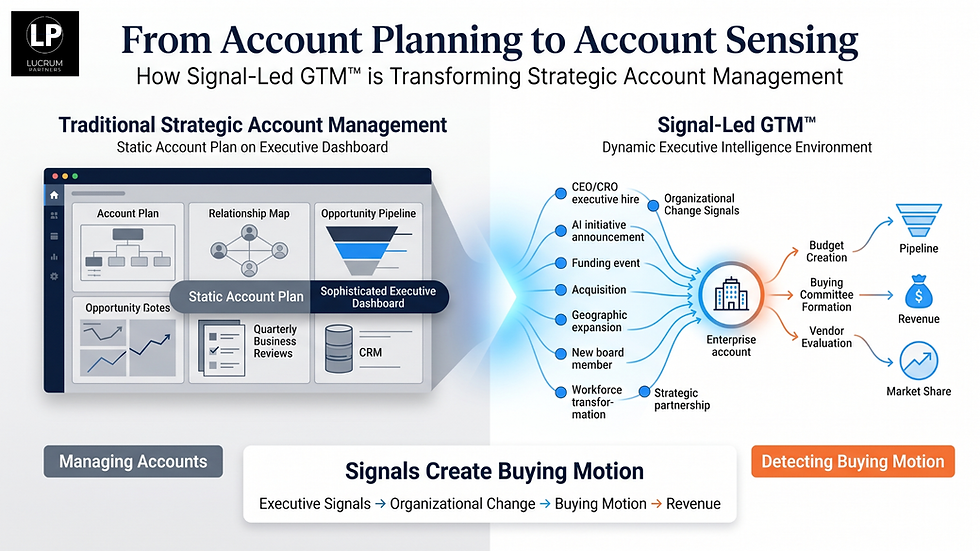
Signal-Led GTM™ Changes the Timing of Engagement
This is where the recent SBI Growth and Polaris I/O research becomes critically important.
The study analyzed:
58,000+ business evolution signals
Across 46 enterprise accounts
Over a 12-month period
The findings were staggering.
“Signal-driven teams generated 4x more qualified opportunities.”
“They converted those opportunities at a 71% rate, versus 20% for traditional approaches.”
“Signal-driven teams closed deals 7.4x larger and 128 days faster.”
Those numbers are not incremental improvements. They represent a fundamentally different operating system.
The difference was not more sellers.
Not more outreach.
Not more sequences.
Not better CRM hygiene.
The difference was timing.
Signal-driven teams engaged while business conditions were evolving — before demand became visible to traditional lead-generation systems.
GTM Systems Are Breaking Faster Than Companies Can Repair Them
The executive turnover data tells the same story.
According to Spencer Stuart’s 2025 CMO tenure research, average CMO tenure among S&P 500 companies declined again to approximately 4.1 years.
Meanwhile, CRO turnover continues to accelerate across high-growth organizations as boards and CEOs demand predictable growth in increasingly unstable buying environments.
At the same time, CEOs themselves are losing confidence in organizational execution.
SBI Growth research consistently highlights a widening gap between growth ambition and confidence in execution capability among executive leadership teams.
And seller turnover remains persistently high.
According to SHRM and broader workforce studies, commercial roles continue to experience significant burnout, pressure, and turnover due to rising complexity and performance expectations.
Why?
Because organizations continue trying to optimize late-stage selling motions while buyers continue moving upstream. This creates impossible expectations for sellers:
Enter late
Compete after requirements are defined
Navigate larger buying committees
Defend against incumbent bias
Forecast accurately
And somehow improve win rates
The math no longer works.
The Real Problem Is Not Sales Effectiveness
It is GTM architecture. Most firms are still operating:
Lead-led systems
MQL-centric measurement
Funnel-stage reporting
Reactive opportunity management
Lagging indicators disguised as insight
But modern growth belongs to organizations capable of:
Detecting business evolution signals early
Engaging before active demand appears
Helping buyers shape problems
Influencing buying criteria upstream
Aligning marketing, sales, customer success, and leadership around signal governance
This is the shift from lead management to signal governance.
And it changes everything.
Final Thought
Sales leaders cannot continuously improve win rates if the GTM strategy forces them to arrive after the buyer has already decided how to think.
That is not a seller capability issue. That is a system design failure.
The organizations that win the next decade of B2B growth will not simply generate more leads.
They will identify and govern signals earlier than competitors.
Because in modern B2B, the winner is often determined before the opportunity officially exists.


Comments