
From Account Planning to Account Sensing: What the 2026 SAMA Conference Revealed About the Future of Strategic Account Management

By Brian Shea, Lucrum Partners
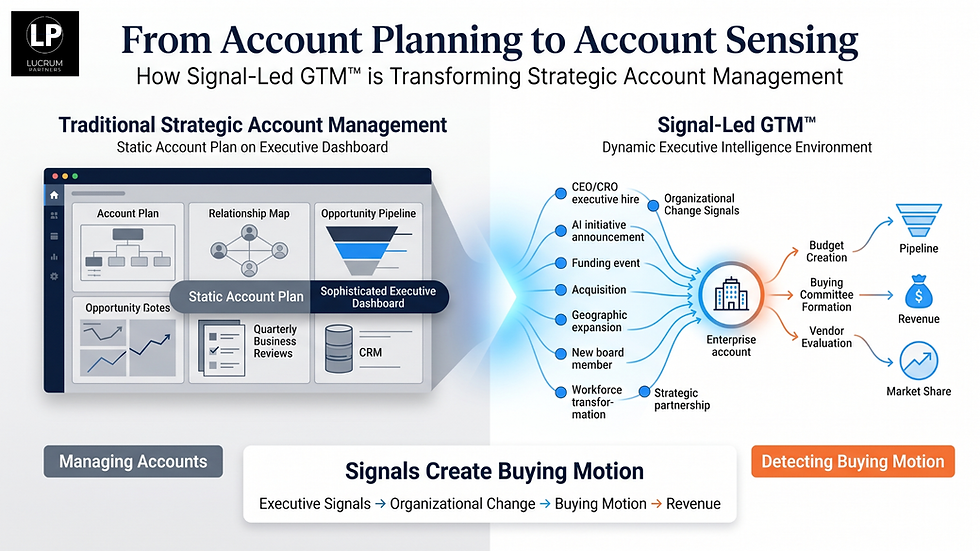
For years, Strategic Account Management (SAM) has centered on a familiar set of disciplines:
Account plans
Relationship maps
Executive sponsorship programs
Quarterly business reviews
Growth plans
Opportunity management
These practices remain important.
But after reviewing the themes, sessions, and practitioner discussions emerging from the 2026 Strategic Account Management Association (SAMA) Conference, one conclusion became clear:
The future of Strategic Account Management is no longer about managing strategic accounts. It is about detecting strategic change.
The organizations highlighted at SAMA are beginning to recognize a reality that many commercial organizations still miss:
By the time an opportunity appears in the CRM, most of the buying motion has already begun.
That realization creates a direct bridge between traditional SAM and what we call Signal-Led GTM™.
The Biggest Shift: From Managing Customers to Sensing Change
Across sessions focused on AI, executive sponsorship, adaptability, customer-centricity, procurement transformation, account team alignment, and hypercare execution, a common theme emerged:
Organizations are attempting to become more proactive rather than reactive.
The language may differ.
Some call it customer-centricity.
Others call it adaptability.
Others call it executive alignment.
But underneath those labels is a common challenge:
How do we recognize meaningful organizational change before it becomes a formal buying process?
That is the central question of Signal-Led GTM™.
Hilton's Executive Sponsorship Evolution Signals a Larger Trend
One of the most notable sessions came from Hilton, which returned to share the evolution of its executive sponsorship program for global strategic accounts.
The session focused on:
Executive alignment
Sponsorship governance
Sponsorship scorecards
Executive training
Measurable outcomes
At first glance, this looks like a traditional SAM topic.
It is not.
The significance lies in what it represents.
Leading organizations increasingly recognize that account growth is determined less by seller relationships and more by executive relationships.
The challenge is that most executive stakeholders do not reveal strategic priorities during vendor meetings.
Those priorities become visible through signals:
New executive hires
Organizational restructures
AI initiatives
M&A activity
Geographic expansion
Cost optimization mandates
Board directives
Digital transformation programs
Executive sponsorship becomes exponentially more valuable when it is activated by signals.
The executive conversation becomes more relevant because it is tied to a change already underway.
Ciena Demonstrated the Need for Signal-Based Value Conversations
Another notable session featured Ciena and its effort to operationalize margin improvement through negotiation discipline and value-based selling.
One message stood out:
Organizations can no longer win through pricing pressure alone.
This aligns directly with recent research from Corporate Visions, Gartner, SBI, and Polaris I/O.
Customers increasingly demand business outcomes rather than product differentiation.
Yet most account teams still discover business priorities too late.
Signal-Led organizations identify margin pressure before the customer articulates it.
They identify:
Cost reduction mandates
Productivity initiatives
Automation programs
Workforce changes
Supply chain investments
before procurement begins evaluating suppliers.
That creates a fundamentally different commercial conversation.
The Most Important Quote Came From a Storytelling Session
In a SAMA preview, strategic storytelling expert Adrian Davis described three questions every customer is trying to answer:
"What's happening? What's about to happen? What should I do in response?"
This may have been the most important statement from the entire conference.
Why?
Because these are the exact questions executive buyers ask when they experience organizational change.
Signal-Led GTM™ is built around identifying the answers before competitors arrive.
The organizations winning tomorrow's strategic accounts are becoming experts at understanding:
What's changing
Why it matters
Which executive owns the outcome
What action the organization is likely to take
The signal emerges before the opportunity.
AI Is Reshaping Strategic Account Management
AI appeared throughout the conference agenda.
Topics included:
AI-powered account strategy
AI-enabled procurement
AI decision support
AI-enhanced account management
But the real implication is bigger.
AI will not replace Strategic Account Managers.
AI will replace account managers who rely solely on relationship management.
The highest-performing account leaders will increasingly leverage AI to:
Detect account signals
Monitor executive changes
Surface market events
Track strategic initiatives
Identify emerging buying motion
The future SAM professional becomes less of an account coordinator and more of an intelligence-driven business advisor.
Why the Day 1 List Matters More Than Ever
One concept repeatedly reinforced by SAMA discussions is prioritization.
Which accounts deserve executive attention?
Which accounts deserve resources?
Which accounts deserve investment?
Historically, companies answered those questions using:
Revenue
Strategic importance
Existing relationships
Executive preference
The result was often hundreds of "strategic accounts."
In practice, only a fraction were actually entering buying motion.
This is where the Day 1 List becomes critical.
Rather than asking:
Who are our strategic accounts?
The question becomes:
Which strategic accounts are experiencing change right now?
The Day 1 List is not a static account list.
It is a dynamic signal-based view of organizations entering buying motion.
That distinction fundamentally changes resource allocation.
The Organizational Design Shift Nobody Is Talking About
Perhaps the most important takeaway from SAMA was not technology.
It was talent.
Many organizations still staff strategic accounts using profiles optimized for relationship management:
Strong communicators
Consensus builders
Customer advocates
Trusted advisors
Those skills remain important.
But they are no longer sufficient.
Signal-Led Account Management requires additional capabilities.
The future strategic account leader increasingly resembles a hybrid of:
Business Strategist
Able to interpret market forces, earnings reports, organizational priorities, and executive mandates.
Intelligence Analyst
Able to connect seemingly unrelated signals into a coherent buying narrative.
Change Consultant
Able to help customers navigate transformation.
Executive Facilitator
Able to create alignment among multiple senior stakeholders.
AI-Augmented Decision Maker
Able to leverage technology to identify opportunities before competitors.
The Emerging Signal-Led Account Team
The most progressive organizations are quietly moving toward a new operating model.
Traditional Structure:
Account Executive
Strategic Account Manager
Sales Engineer
Emerging Structure:
Signal Intelligence
Strategic Account Leader
Executive Sponsor
Industry Subject Matter Expert
Customer Success
Marketing
AI-Augmented Research Support
This mirrors many of the conference discussions around team-enabled account management, executive sponsorship, hypercare programs, and cross-functional collaboration.
The account team of the future is not larger. It is more informed.
The Future of Strategic Account Management
The strongest message emerging from the 2026 SAMA Conference is not about AI.
It is not about account plans.
It is not about executive sponsorship.
It is not even about customer-centricity.
The message is this:
Strategic Account Management is evolving from managing relationships with important customers to detecting, interpreting, and acting on signals of organizational change.
Organizations that continue to focus primarily on opportunity management will find themselves entering conversations after buying decisions are already underway.
Organizations that develop signal detection capabilities will identify buying motion before competitors know it exists.
That is the difference between managing accounts and managing outcomes.
And it may be the most important evolution Strategic Account Management has experienced in the last twenty years.


Comments