
.png)
Part II Revenue Governance: A Three-Part CEO Series

Part II: The Two Blind Spots Your Revenue Tech Stack Still Can't See

There is an image I have been looking at recently that should get the attention of every CEO responsible for a B2B growth strategy.
It is the sales technology landscape.
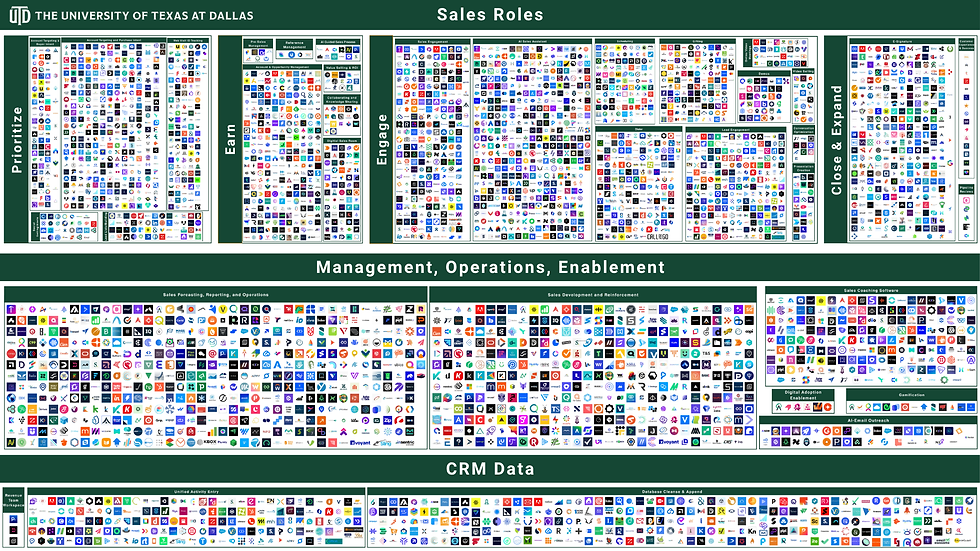
Hundreds of companies organized around virtually every imaginable part of selling: prioritization, prospecting, engagement, enablement, coaching, conversation intelligence, CRM, forecasting, closing and expansion. The landscape the user provided visibly spans sales roles, management/operations/enablement, and CRM data across the selling process.
It is impressive. It is also revealing.
Because when you stop looking at the number of technologies and instead ask where they operate, an uncomfortable pattern emerges.
We have spent enormous amounts of money instrumenting the middle of the revenue process. Yet two of the decisions with the greatest influence on revenue remain remarkably difficult for management to govern.
Blind Spot #1: Before the opportunity
Every CEO knows the cost of entering a deal too late. What is less visible is just how early "too late" can now be. Buyers don't wait for sellers to begin understanding a business problem. Executives consult peers, existing relationships, analysts, digital sources and increasingly AI. They form opinions about the problem and possible solutions long before an opportunity appears in CRM.
That means the conventional question.... Who is showing intent?.... is becoming less useful on its own.
The better question is: What is happening inside the account that could cause executives to begin reconsidering the status quo? That is a market-sensing problem.
A change in leadership.
A disappointing earnings result.
A new strategic priority.
Margin deterioration.
An acquisition.
A regulatory shift.
A major customer event.
Capital moving into a new initiative.
Individually, these are information. Interpreted correctly, they become signals.
And the distinction matters.
The objective isn't to produce more accounts for sales.
It is to identify a qualified at-bat: the intersection of timing, business context and executive relevance that gives the company a legitimate opportunity to participate while the problem is still being shaped.
Most companies have far more technology for contacting accounts than they have governance for determining which accounts deserve contact now.
That's the first blind spot.
Blind Spot #2: Inside the opportunity
Once an opportunity is created, the technology becomes considerably more sophisticated.
We can record the call.
Analyze the conversation.
Track email engagement.
Recommend content.
Identify stakeholders.
Score the opportunity.
Predict the close date.
Coach the seller.
Update the forecast.
But there is still a deceptively simple question: What did the buyer do?
Not the seller. The buyer.
What commitment did the buying organization make that provides evidence it is progressing toward a decision?
This distinction sounds obvious until you examine a pipeline.
A second meeting is seller activity.
Sending a proposal is seller activity.
Adding three contacts is seller activity.
Moving the opportunity to Stage 4 is seller activity.
None, by itself, proves that a buying organization has moved closer to making a decision.
Yet much of revenue management still treats those activities as proxies for progress.
Then quarter end arrives. Deals slip. Forecast calls become negotiations. Management asks why an opportunity that looked healthy for 90 days suddenly stopped moving. Often, it didn't suddenly stop. We were measuring the seller instead of the buyer.
The middle isn't the problem.
This is where the technology consolidation story becomes interesting. The industry has spent years combining capabilities across enablement, engagement, intelligence and forecasting. That work has value. The mistake would be assuming that consolidating the technology also solves the operating-model problem. It doesn't.
The CEO still needs evidence at two critical moments:
At entry: Why this account, and why now?
During execution: What has the buyer done that proves the deal is moving?
Get the first wrong and sellers spend expensive time pursuing accounts without sufficient reason to change.
Get the second wrong and management carries opportunities that aren't as real as the forecast suggests.
Everything downstream is affected. Pipeline quality. Resource allocation. Win rates. Sales cycles. Forecast confidence. Ultimately, revenue.
This is why I believe the next evolution in GTM will be less about adding another seller technology and more about governing the evidence surrounding the seller.
Market evidence before the opportunity.
Buyer evidence during the opportunity.
And a revenue operating system connecting the two.
The industry has invested heavily in making sellers more productive. The next question for CEOs is whether the company has become equally good at determining where sellers should spend that productivity, and whether the buyer is responding.


Comments