
Why 2026 B2B Conferences Are Still Training Revenue Teams for an Outdated Buyer Journey

What the 2026 conference circuit reveals about why so many B2B revenue systems are entering too late
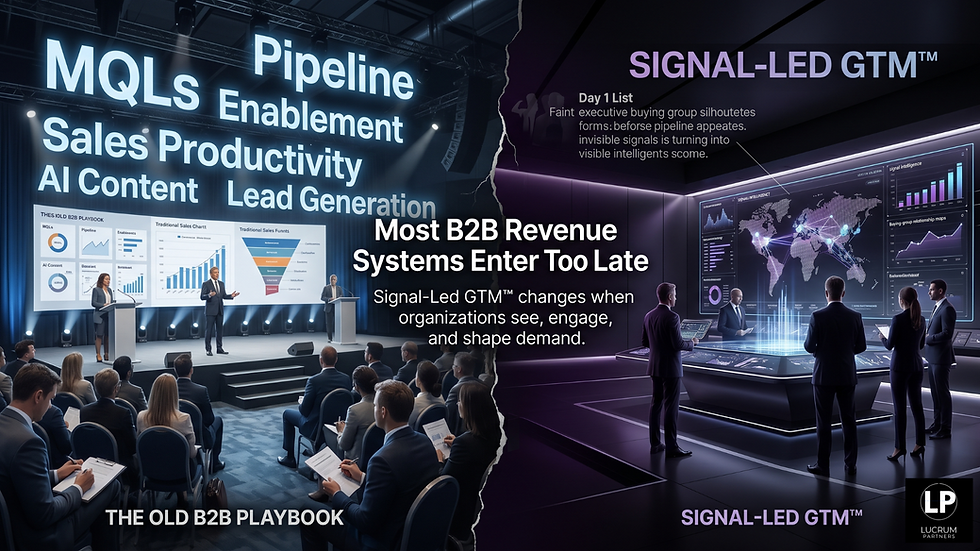
Over the past several weeks, I reviewed the agendas and keynote themes from the major commercial leadership conferences shaping B2B strategy in 2026:
And while the branding, terminology, and AI language have evolved, one pattern remains remarkably consistent:
The overwhelming majority of sessions are still focused on improving execution after buyers have already entered an active buying process.
That’s a serious problem.
Because modern B2B growth is increasingly determined before pipeline exists.
The industry continues discussing:
productivity
enablement
workflow optimization
AI acceleration
coaching
personalization
pipeline conversion
account orchestration
But very little attention is being given to:
how buyers form the Day 1 List
how executive priorities emerge before active demand
how buying groups shape requirements before vendor engagement
how organizations detect pre-intent signals
how GTM systems should govern signal interpretation and activation
how firms become visible before formal buying cycles begin
And that absence matters more than most leaders realize.
Conferences Reveal an Industry Still Optimizing for a Late-Stage Revenue Model
1. Gartner CSO Conference: Productivity Over Timing
The 2026 Gartner CSO conference heavily emphasizes AI-enabled productivity, workflow redesign, and sales efficiency.
Session examples include:
“Reimagining Sales Productivity in the Age of AI”
“The AI-First Sales Organization”
“AI That Actually Sells”
Those are important topics.
But here’s the strategic gap:
The discussion largely assumes the organization is already engaged in an active revenue motion.
The dominant focus remains:
improving seller efficiency
increasing throughput
optimizing workflows
accelerating decisions inside active pipeline
What’s missing is the upstream question:
How does an organization become visible before buyers formally enter market?
There is minimal visible emphasis on:
pre-intent signal detection
shortlist formation
executive issue emergence
latent demand visibility
early buying-group mapping
Day 1 List inclusion strategy
In effect, much of the conference still centers around improving the performance of systems that activate after buyers already narrowed the field.
2. Forrester B2B Summit: Closer to the Problem, But Still Operationalizing Too Late
To Forrester’s credit, their 2026 summit gets closer to acknowledging the shift.
The agenda references:
AI-driven buyer autonomy
collapsing traditional funnels
GTM singularity
the need for new operating models
buyers conducting more independent research
Forrester also openly acknowledges that buyers increasingly self-navigate and arrive highly informed.
That’s directionally correct.
But the event still primarily focuses on:
aligning GTM functions
orchestrating programs
AI workflow integration
content visibility
measurement modernization
Again, valuable discussions.
But there is still limited executive-level focus on:
governing signals before pipeline creation
identifying latent opportunity emergence
shaping buyer problem definition before requirements harden
influencing the buying group before vendor comparisons begin
Even the language of “demand generation” often implies the organization is reacting to visible market activity rather than governing early market intelligence.
The conference recognizes buyers changed.
But many of the proposed remedies still activate after the buying process is already underway.
3. ATD: Training a Workforce for a Buying Motion That Is Disappearing
The 2026 ATD conference may be the clearest example of the industry’s timing problem.
The event features:
35+ AI learning sessions
enablement modernization
leadership capability development
AI learning integration
immersive workforce development
Again: important conversations.
But nearly all of them assume the core commercial operating model itself remains valid.
The dominant framing is:“How do we better train the workforce?”
Rather than:“Has the buyer motion fundamentally changed in a way that invalidates the current system?”
There is very little discussion around:
how modern buyers form preferences before engagement
how commercial teams gain access before active buying
how organizations detect executive priority shifts
how to operationalize pre-intent intelligence
how to identify account-level signal emergence
In many ways, ATD still reflects a world where:
pipeline is the primary visibility mechanism
enablement begins after opportunity creation
sellers enter once buying formally starts
But today’s buyers increasingly complete substantial portions of their journey before direct
engagement.
Training sellers later in the process does not solve early invisibility.
4. Strategic Account Management Conferences: Expanding Existing Relationships While Missing Early Expansion Signals
The strategic account management community has evolved meaningfully over the last decade.
The focus on:
relationship orchestration
executive alignment
account growth
customer value realization
…is directionally strong.
But many account management sessions still emphasize:
managing existing strategic relationships
improving account planning
expanding active accounts
stakeholder alignment after engagement already exists
The major gap?
Expansion signals often emerge long before account teams formally recognize opportunity movement.
Most account growth systems still lack:
signal governance
executive priority monitoring
buying network expansion detection
competitive signal intelligence
pre-expansion visibility systems
As a result, many firms discover expansion opportunities only after:
budgets are already discussed
competitors are already engaged
internal coalitions already formed
Strategic account management often still operates as relationship optimization rather than signal-led opportunity governance.
5. MarCom Summit: Optimizing Visibility While Buyers Quietly Self-Navigate
Marketing conferences increasingly recognize:
AI search disruption
declining engagement metrics
content overload
audience fragmentation
digital buyer autonomy
Forrester itself recently warned that AI search is reshaping discoverability and accountability models.
Yet many MarCom sessions continue emphasizing:
content optimization
channel strategy
campaign orchestration
engagement metrics
personalization engines
Those approaches still largely assume:
buyers are discoverable
intent is visible
engagement signals appear early enough
campaign interaction equals buying relevance
But modern executive buyers often move quietly.
They research privately.They validate through trusted networks.They form preferences before engagement.They increasingly avoid visible buying behavior until much later.
Which means many marketing systems are still measuring activity instead of governing signals.
The Core Problem: Most Conferences Still Assume Pipeline Is the Beginning of the Revenue Process
It isn’t.
Pipeline is increasingly the output of a buying process that already started elsewhere.
That changes everything.
The firms outperforming today are not simply:
training sellers better
generating more MQLs
improving workflows
adding AI copilots
producing more content
They are developing systems to:
detect market movement earlier
identify executive priority shifts
monitor latent demand signals
map buying-group evolution
engage before requirements harden
influence the Day 1 List before competitors appear
That is the essence of Signal-Led GTM™.
Not better execution inside the existing system.
A redesign of the system itself.
The Revenue Risk for Organizations Following Only These Conference Playbooks
If organizations adopt only the dominant practices being emphasized across today’s conference circuit, several risks emerge:
1. They will optimize execution inside shrinking buying windows
AI acceleration improves speed.
But speed inside a late-stage process does not fix late visibility.
2. They will continue entering after buyer preferences already formed
Modern buyers increasingly:
self-educate
self-organize
self-shortlist
Without signal-led visibility, firms remain reactive participants rather than early influencers.
3. Enablement investments may improve activity without improving strategic access
Organizations may:
coach better
personalize faster
automate more efficiently
…while still missing executive conversations where demand is actually shaped.
4. Marketing teams may create more noise while becoming less visible to executive buyers
Content volume is increasing faster than buyer attention.
The future advantage is not more campaigns.
It is earlier relevance.
5. Revenue forecasts will remain unstable
Because most pipeline systems are still lagging indicators.
Without upstream signal visibility, organizations continue learning about risk after:
priorities shift
budgets move
competitors advance
buying groups align elsewhere
The Industry’s Next Shift Isn’t Better Enablement
It’s timing.
The next generation of market leaders will not simply:
train harder
automate faster
personalize more
coach better
They will govern signals earlier.
Because the companies shaping demand before pipeline exists will increasingly outperform the companies optimizing execution after buyers already decided.


Comments