
They Pay for Water: Memories From the XM Satellite Radio Roller Coaster

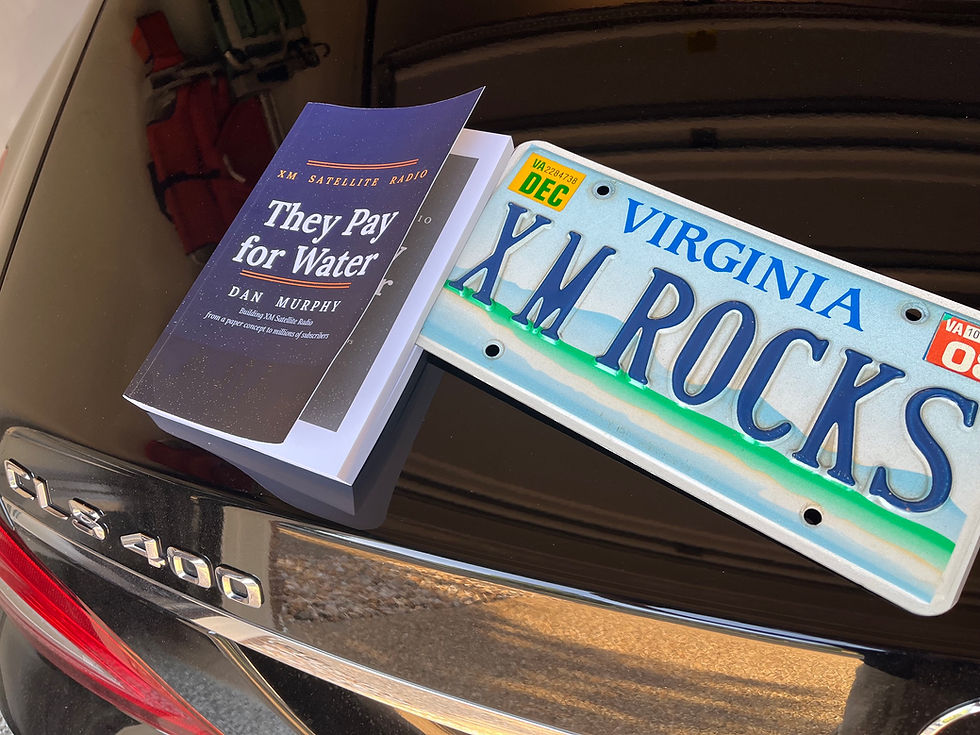
I finished Dan Murphy’s new book, They Pay for Water, and I’m not sure I read it the way most people will.
Dan was my boss at XM Satellite Radio from the time we launched commercial service through the eventual merger with Sirius. So reading the book wasn't really reading someone else's business story. It was more like opening a box that had been sitting in the attic for 20-plus years. Names I hadn't thought about in a long time. Meetings. Retail partners. Artists walking through the halls. Subscriber targets. Technology debates. Legal requests. Launch events. The incredible highs and the moments when you wondered what could possibly happen next.
And Dan.
Anyone who worked for Dan will probably recognize my description of him: mentor, guide and very much a New Yorker who believed that eventually you had to stop talking about something and just get it done. He expected performance, but he invested in the people responsible for delivering it. I learned a tremendous amount working for him.
Dan's book starts before most consumers had ever heard of XM, when satellite radio was still largely an idea and an enormous financial, technological and commercial bet. I joined the ride as we were turning that bet into a commercial business, and his account reminded me just how audacious the entire thing was.
We were asking Americans to pay for something they had received for free their entire lives.
“Who will ever pay for radio?”
Dan heard some version of that question constantly. His answer eventually became the title of the book: “They pay for water, right?”
Twenty-some years later, it still makes me laugh.
Get the Subscribers
One story in Dan's book immediately took me back. Our CEO, Hugh Panero, had a sign with three operating goals: Get the Subscribers. Get the Subscribers. Get the Subscribers.
That was about as complicated as our strategic alignment needed to be.
The executive team assembled around that mission was remarkable. XM recruited some of the best people in broadcasting, technology, consumer electronics, automotive, finance, music and media. On paper, it was a hall-of-fame assembly of talent. In person, I'm not sure we always looked like a polished collection of industry executives. We probably looked more like a ship full of pirates preparing to conquer something.
And, frankly, we were.
One of the programming team's mantras became part of XM lore: AFDI—Actually Fucking Doing It. It wasn't a corporate value painted on a wall. It was an attitude. Problems were going to occur. Plans were going to change. Things that had never been done before were going to have to get done. Eventually, somebody had to stop talking about the problem and solve it.
Dan's book does a great job chronicling just how often that was required. Our national commercial launch was planned for September 12, 2001. Then September 11 happened.
Think about the circumstances. Enormous amounts of capital had been raised. Satellites were in space. Radios were being manufactured. Retail plans were being built. Marketing was underway. Years had been spent convincing people that an entirely new category was going to exist. Then the world changed overnight.
There wasn't a chapter in a management textbook telling us what to do next. We kept going.
That somber fourth quarter of 2001 became the beginning of something my team and I would be proud of for years: our streak of subscriber performance against plan.
A Front-Row Seat to Some Extraordinary People
One of the things Dan's book made me appreciate again was how much learning was available simply by walking down the hall at XM. On any given day, I could sit down with someone who was genuinely one of the best in the world at what they did, ask a question and get what amounted to a private masterclass. Most were remarkably generous with their time. Dan is at the top of that list, but there were many others.
Lee Abrams, our co-founder and Chief Programming Officer, would let me pull up a chair in his office, surrounded by gold and platinum records, and talk about the science of programming. Lee taught me why people listen, how stations are designed and how an audio experience can be intentionally constructed. This was light-years away from the talking-head, goofy-FM-radio version of the medium many people knew.
Tony Masiello could take me even deeper into the technology. Tony was a broadcasting legend and a registered “golden ear.” As a former musician and lifelong music wonk myself, I could listen to him forever. Codecs, compression, Neural Audio, audio decoding—Tony could explain why something sounded the way it did and the technology required to make it better.
Then there was Dr. Stell Patsiokas. Stell had spent more than 20 years at Motorola and was simply brilliant. Think about the engineering challenge XM was solving: delivering more than 100, and eventually 150-plus, channels with incredible fidelity through a constrained satellite pipe. Stell and the engineering organization helped make something that sounded impossible work.
Robert Acker, whom Dan features heavily in the book, was one of the co-architects of the XM business plan. Robert had that rare combination of tremendous intellect and tremendous approachability.
I also need to give a special thank you to Don Krcmarik, our VP of OEM Application Engineering. Don seemed to be involved in just about every early retail show where we needed engineering magic to make XM work exactly as promised. In those early days, indoor satellite reception wasn't something you simply took for granted. Trade shows required rugged antenna installations, repeaters and a lot of engineering creativity to make sure thousands of people walking onto a show floor could experience XM the way we wanted them to.
Dan had a nickname for Don and me: his bullpen. Don was left-handed. I'm right-handed. When XM needed engineering magic, Dan would call in the lefty to save the game. When there was a retail or product-distribution problem that needed to be solved, he'd bring in the righty. I'm not sure either of us ever officially agreed to being relief pitchers, but the description stuck, and it was pretty accurate. More importantly, Don became a great friend.
CES could be relentless in those years. Long days on the floor usually turned into long nights with partners, customers and the XM team. Somehow, after all of that, Don could still sit up half the night talking about life. We had a lot of those conversations over the years.
I tried to keep up. I couldn't. I'm still not convinced Don ever slept. When I think about the people who made XM special, I think about people like Don. Brilliant at what he did, always willing to jump into the next problem, and someone you were genuinely happy to be sitting beside when things got difficult. The technology mattered enormously at XM, but so did the friendships built while we were figuring out how to make all of it work.
I could keep going. Looking back, I sometimes say that I earned a Ph.D. in business development during my years at XM. That's not because of any single job responsibility or training program. It was because I spent years surrounded by people like these while we collectively tried to solve problems that often hadn't been solved before.
Then You Had to Put the Product in Someone's Hands
Technology doesn't build a category by itself.
One of my favorite memories involved Leslie Shapiro and Ken Pohlmann from Sound & Vision, one of the leading authorities on high-fidelity equipment at the time. They took XM and our competitor's satellite radios on a cross-country road trip. That was a pretty good test: mountains, highways, cities, urban canyons and thousands of miles of real-world conditions. Ken was a tenured professor and director of the Music Engineering Technology program at the University of Miami. Leslie had studied music there as well. These weren't people who were going to be fooled by marketing language about sound quality.
Their experience validated what we believed we had built. XM's CD-like fidelity and signal performance made the trip an incredible listening experience. The competing product suffered more frequent signal interruptions and lower fidelity. I remember thinking they worked pretty hard in the eventual write-up not to bury the other guys.
For those of us selling XM, independent validation like that mattered. We knew what our engineers had built. Now other people were hearing it. None of that happened by chance. (And for the record, the Sirius team blew a gasket when the article published)
The Retailers Who Took the Bet With Us
My part of the XM story was heavily connected to retail, and Best Buy, Circuit City and Crutchfield became three of our largest and most important partners.
It's easy to forget how much influence retailers had in the consumer electronics world at that time. Getting onto a shelf was hard. Staying there was harder. Buyers were accountable for things like sales per square foot. They didn't have room for interesting science projects. XM had to perform.
The economics behind those relationships were also complicated. A retailer could earn money selling the radio itself, with XM subsidizing radio costs through the manufacturer. There was a service activation commission, and there was a recurring residual as long as the subscriber remained active. That's an attractive model for the retailer. It becomes considerably more interesting when you're sitting on the XM side of the table and the consumer is initially paying you only $9.99 a month.
Out of that economic model also came the costs of satellites, terrestrial repeaters, music royalties, customer acquisition and everything else required to operate the system. Later, the monthly subscription moved to $12.95, but there still wasn't a giant pool of money sitting around waiting to be divided.
So we renegotiated. More than once. Those weren't always easy conversations. Our partners certainly didn't enjoy giving something back or restructuring an agreement. What I remember, however, is that the good ones came into those conversations looking for a way for both businesses to win. That's partnership, particularly when the business you're helping build is still finding its economic footing.
Brad Anderson, Gary Arnold and Mike Manske at Best Buy were tremendous supporters. At Circuit City, Alan McCollough, Wes Lowzinski, Myke Lynch, Randy Wick and Ray Leake were equally important to us. At Crutchfield, Bill Crutchfield, Rick Souder and Carl Matthews got what we were trying to build.
These companies had to remain appropriately agnostic in how they represented the category, and we understood that. But we'd also spend hours talking about their favorite XM channels, personalities and programming. They weren't simply retail partners anymore. Many had become genuine fans.
One of the proudest moments for my team was being named Vendor of the Year by both Best Buy and Circuit City in the same year. Those awards sat outside Hugh's office, and yes, I occasionally pointed to them as evidence that Hugh had a pretty good sales team working for him.
My Own XM Rock Stars
I can't write about XM without recognizing the people on my own team: Zach Kovolenko, Kent Brodsho, Todd Bogart, Lora Stickney, Paul Trueman, Mark Blair and Jeff Waters.
“Get the Subscribers” eventually had to become something more than a sign outside the CEO's office. Someone had to get them.
We did it relationship by relationship, location by location, city by city and ultimately subscriber by subscriber. We built programs, trained retail teams, developed local relationships, solved problems and tried things that hadn't been tried before. There was a genuine passion for spreading the XM brand.
And we delivered.
I kept a performance chart showing subscriber results against budget, and I loved sharing it with our retail partners at every opportunity. Were we bragging? Okay, maybe a little.
But there was a strategy behind it. We were telling them: We told you this category would perform. We told you we'd deliver. We did.
Or, in XM language, we AFDI.
So now let's talk about your next forecast. XM needs more orders. We deserve more space. Let's go bigger. Performance earned us the right to have that conversation.
When XM Became More Than a Radio

By 2002, something strange started happening. I'd be walking through an airport wearing an XM jacket and have strangers approach me asking for XM swag.
Think about how quickly that happened. A year earlier, people were asking why anyone would ever pay for radio. Now people wanted the logo.
That's when I started understanding that we weren't only building a subscription service. We were building a following.
The same thing was happening with artists. Some of my favorite XM memories happened almost accidentally, and they remain some of the stories I enjoy telling most.
Quincy Jones stood signing autographs and taking photographs with hundreds of our guests at CES. He didn't have to do that. He did it because he genuinely loved XM.
One day my four-year-old daughter was staring through the studio glass at Willie Nelson. Willie noticed her and came out. She immediately ran behind my leg. Willie laughed and told me he had that effect on kids.
I once had a conversation with B.B. King while the two of us were walking to the XM bathroom. B.B. was genuinely excited about what we were building. He appeared in our original launch advertising, and his name was attached to our blues channel.
Gavin Rossdale once thanked me for paying for his second wedding to Gwen Stefani after he played a private beachfront event for our retail partners from Circuit City. They had both a U.S. and U.K. wedding. I'm still not sure which one I apparently paid for.
Junior Marvin shared stories with me about playing with Bob Marley. Richard Belzer told me over lunch that he discovered XM after receiving a royalty check connected to our award-winning comedy programming. Terrestrial radio didn't compensate performers in the same way, and he hadn't expected it.
I remember being at the Daytona 500 during a rain delay with Fergie and her then-husband Josh Duhamel talking enthusiastically about XM while Jay Leno and Kid Rock entertained a relatively small group of us.
And Jon Anderson, the frontman of Yes, was frequently around XM's Washington facility. Jon was an absolute gentleman. We spent more time discussing wonderfully obscure music trivia than I could possibly reconstruct today.
Those experiences sound surreal when I write them down now. At the time, somehow, they just became part of going to work at XM.
It Wasn't All Willie Nelson and B.B. King
Dan's book also reminded me about the less glamorous side of disrupting an industry.
The recording industry. Music labels. The FCC. The FTC. Congressional inquiries. Lawyers. Regulatory battles. The government and industry headwinds seemed almost constant.
I remember the first time I had to turn over my business records to one of our retained law firms. It was jarring. Eventually, I just kept duplicate files in bankers boxes because I figured another subpoena or document request was probably coming.
You adapt.
What feels extraordinary the first time eventually becomes part of the operating environment. You stop spending energy complaining that it shouldn't be happening and build the ability to deal with it.
There was also another side of XM that I don't want lost among the subscriber numbers and celebrity stories. We were able to do some meaningful philanthropic work.
We supported the Best Buy Foundation and its efforts to bring technology, education and career-development opportunities into underserved communities. Through the CEDIA industry, we supported Rooms of Magic, which helped bring movies and entertainment to terminally ill and hospital-bound children.
I remember talking with Joan Osborne before I was scheduled to give a keynote at a fundraising event supporting those rooms. It became an unexpectedly emotional conversation about the children. Thanks, Joan. Now I had to walk on stage.
But that's another thing I remember about those years. There was a lot of humanity mixed into all of the insanity.
They Did Pay for Water
Eventually, the numbers settled the argument. XM raced through one million subscribers, then two million, then three million and kept going. Dan's book eventually reaches CHURN and SAC, Howard Stern, the competitive battles and finally the conclusion that a merger with Sirius had become necessary.
I won't try to retell those stories. They're Dan's, and he tells them better because he was sat in the executive and investor rooms I wasn't.
What I can add is what it felt like from where I sat, where much of the strategy had to become commercial execution. It was exhilarating, exhausting and occasionally absurd. It was also one of the greatest business educations I could have received.
Reading They Pay for Water left me thinking about leadership teams today. We talk a lot about transformation, disruption, agility, resilience and innovation. They've become comfortable business words.
XM wasn't comfortable.
That's why I would challenge leadership teams to read Dan's book and then look around their own table. Would you want this group beside you for that ride? Would they still function when the launch date disappeared, financing became difficult, regulators arrived, partners wanted new economics, the technology had to do something that hadn't been done before and your competitor was fighting for the same customer and the same shelf space?
Could they disagree hard and still move forward? Could they learn from one another without ego? Could they renegotiate a partnership without destroying the relationship? Could they take a punch, come back the next morning and get the subscribers?
That's the part of the XM story that stays with me.
It wasn't one brilliant leader, one technology or one strategy. It was an unusual collection of extraordinarily talented people, partners and personalities who built an operating culture capable of absorbing one problem after another without losing sight of what we were there to accomplish.
Get the Subscribers. Get the Subscribers. Get the Subscribers.
More than two decades later, I still carry lessons from Dan, Lee, Tony, Stell, Robert, Hugh and many others into the way I think about leadership, teams, partnerships and execution.
I went to XM to help build a business. I left feeling like I'd earned a Ph.D. in business development.
And after reading Dan's book, I'm reminded of something else. He was right all along.
They will pay for water. You just have to give them a reason to. And then you have to AFDI.


Comments